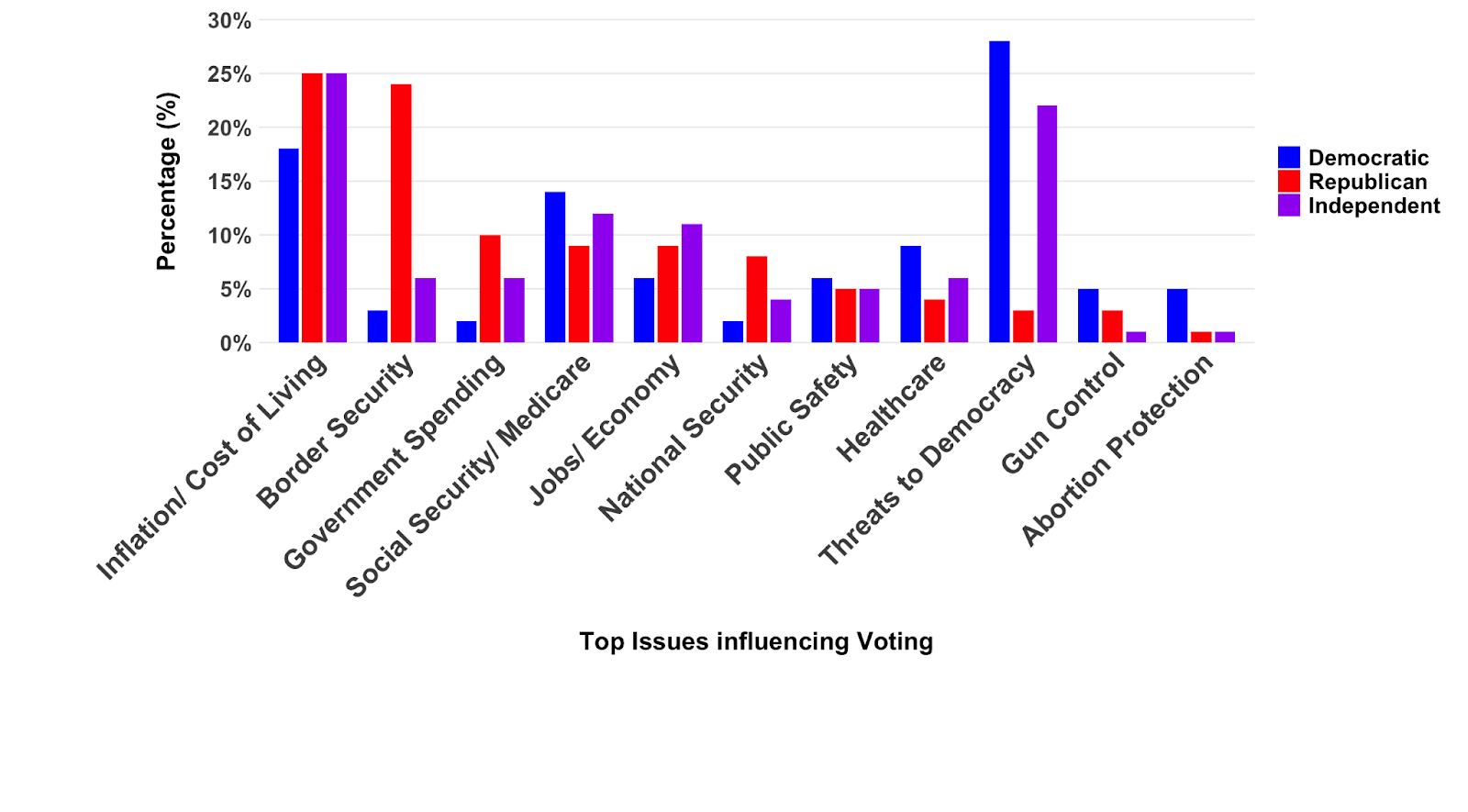
In an era of deep political division, understanding what motivates voters across party lines is crucial for effective policymaking. A June 2025 Cygnal survey of U.S. general election likely voters (n=800 nationally representative sample: 43% Republicans, 39% Democrats, and 18% Independents) reveals stark differences in top priorities at the time by partisanship, setting the stage for analyzing how Bitcoin-related attitudes influence support for pro-Bitcoin lawmakers. Notably, Democrats who prioritized “Threats to Democracy” at 28%, far outpaced Republicans (3%) and Independents (22%), while economic concerns like “Inflation and Cost of Living” were a top concern for Republicans and Independents (25%).
Figure 1: Top Issues Influencing Voting Behavior by Political Affiliation
By exploring cross-tabulations of priorities and developing a logistic regression model, we analyzed how ideological framings such as Bitcoin’s energy impact, the right to transact freely, and access for those in under-served countries predict voter support, offering insights for lawmakers seeking bipartisan appeal.
To delve deeper, we employed logistic regression models on partisan subsamples of 800 respondents, with support for pro-Bitcoin lawmakers as the binary dependent variable (“more likely to support” vs. “less likely”). Predictors were derived from three key questions: (1) whether bitcoin helps or hinders the U.S. energy grid, (2) the extent to which bitcoin provides financial freedom to people in countries with unstable governments or limited banking, and (3) support for individuals’ right to use bitcoin for lawful purposes without government interference. Models were run separately for Republicans, Democrats, and Independents, controlling for bitcoin ownership and additional sociodemographic and attitudinal controls.
Read more of Campbell’s article on the Bitcoin Policy Institute website.