Few things embody American culture and consumerism better than the suburbs.
Both a subject of generational aspiration and comedic ridicule, America’s suburbs remain a bridge to a nostalgic past and the ideal archetype of the “American Dream,” where home ownership, good schools, and safe neighborhoods still represent the opportunity of upward mobility and a prosperous future.
It’s fitting, then, with backyard barbecue season approaching, that, in part three of this series, we examine why the suburbs in America’s South have been politically stagnant.
While many of the country’s suburbs are rapidly shifting, voting behavior and partisanship in Southern suburbs are remarkably stable. This “stuck in neutral” dynamic is shaping the political battlegrounds of tomorrow — and it’s not necessarily a disadvantage for Republicans. If Democrats keep choosing the 20 percent side of 80/20 issues — like men in women’s sports, deporting illegals, or prioritizing the rights of nefarious illegal immigrants over crime victims — they’ll lose votes to Republicans or drive their own voters to stay home in the 2026 midterm elections.
That would be good news for Republicans. But our analysis of the South suggests its suburbs are much more hardened than its northern or western counterparts. Too often, mostly on Election Night, pundits and analysts rush to describe the country’s suburbs as hotly contested areas with high concentrations of swing voters.
While this is true for suburban pockets elsewhere in America, it is not the case in the South.
“As we mentioned in part one of this series, when we described the Sweet Tea Suburbs, their inelasticity reflects a unique dynamic that poses a significant challenge for Republicans,” says Nicholas Valdiviez, Cygnal’s Sampling Lead for this exclusive Daily Wire project. “The GOP could seek to strengthen its performance in other areas to offset suburban stagnation, or they could try to crack through some of these areas, though the payoff would be incremental and likely extend beyond 2026.”
The Faux South: A Case Study in Suburban Inelasticity
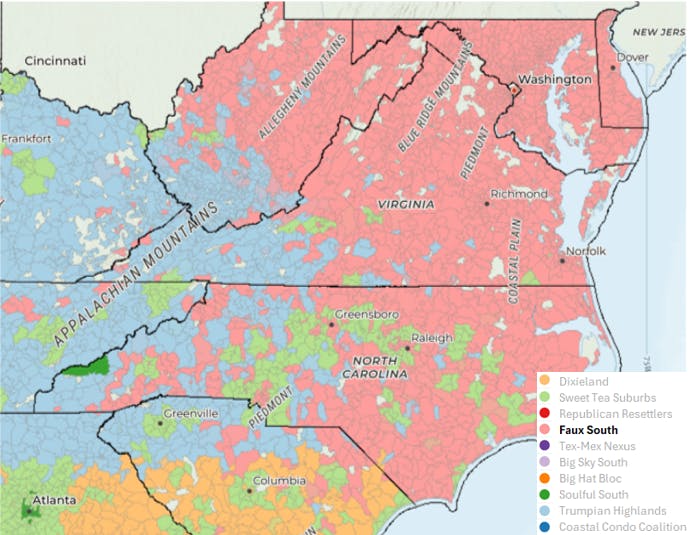
The word faux is not used as a negative slight toward any of the great people or communities of this region, nor to detract from their “southernness.” In fact, as an important descriptor for this far-reaching analysis of America’s South, the term illustrates the region’s distinct and historically vital role as a sprawling gateway to the southern heartlands shaped more by commerce and trade routes than agriculture, combined with its geographical position along the borderlands of our nation’s capital.