It’s easy to oversimplify American politics. But when it comes to our collective understanding of regionality, it really is as simple as North, East, South, and West.
Engrained in the minds across generations, defined by mighty rivers and a brutal Civil War, the South — more than any other region — is more politically consequential than it ever has been. For most of modern American history, the “Solid South” was a real thing that helped Democrats win the White House and the presidency.
Today, it is a myth.
The real story of America’s South, as you’ve been reading in this six-part series, is the story of an emerging patchwork of political intricacies and growing political dominance. Our exclusive analysis of the South shows 10 distinct regions transcending state lines and traditional constructs, showing vulnerabilities and opportunities for both parties – but more for Republicans — if they can capitalize before Democrats find a rudder and sales pitch.
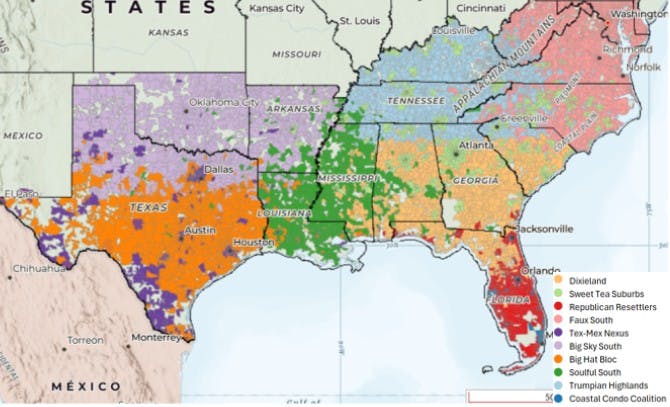
State lines determine the borders for how we’ll count votes, but voters and their stances on key issues of the day don’t adhere to state lines. How well each party understands and adapts to the South’s regional realities will determine the balance of power for the 2026 midterm elections and the rest of Donald Trump’s presidency.
To culminate this deep analysis of aggregated demographic variables, survey responses, and trends in everything from education, income, gender, age, and partisanship, we offer four things Republicans should focus on to achieve political victory in the South.
Base Fortress Regions With GOP Ceilings
Pollsters and political operatives felt the tremors of America’s massive political realignment before most of the mainstream media caught on, but by now it’s common knowledge that Trump’s emergence as the central figure of political life was the catalyst of a growing Diploma Divide.
But Trump reflects an electorate whose political preferences began changing even before he came down that golden escalator.
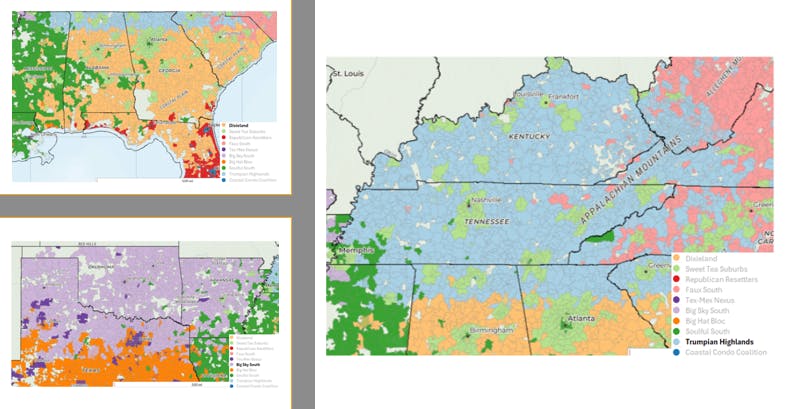
While this realignment has happened nationally, it’s most prominent and evident in the South. For the Republican Party, three main regions anchor its new political advantage. What we’ve dubbed Dixieland, Big Sky South, and the Trumpian Highlands serve as base fortresses from diploma-divide-driven gains from Democrats — but offer little to no room for growth. In 2024, Trump’s ballot shares were 71% in Dixieland, 70% in the Big Sky South, and 75% in the Trumpian Highlands.
“This is about as good as it’s going to get for the GOP in these New South buttresses,” said Nicholas Valdiviez, Cygnal’s Sampling Lead for this project. “These three strongholds are reliable for Republicans, but it’s unreasonable to expect they can deliver more than they already have.”
So what? As we’ve seen in previous cycles, it can be easy to try and offset lagging performance in harder-to-get voter groups by surging turnout in reliable regions like these. But the GOP’s focus should be on keeping turnout and engagement at these levels — which won’t be easy as these areas aren’t growing as much as other Southern regions less friendly to Republicans. There’s more peril in the ceilings of these fortresses if voters are unenthused and stay home.